Broadnax v. AAA Club Alliance: Defense Verdict
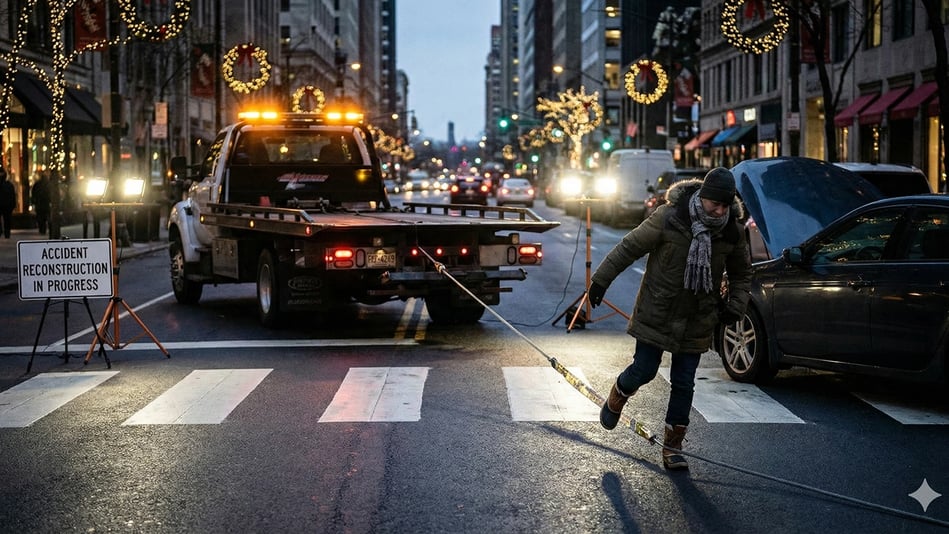
Table of Contents
Case Background
On Christmas Eve of 2022, the bustling holiday atmosphere in West Hartford, Connecticut, turned into a painful ordeal for local resident Dwight Broadnax. Around 5:15 p.m., as evening settled over the town, Broadnax was walking along Farmington Avenue, a busy public roadway. He traveled specifically within the innermost portion of the road, an area he identified as the designated pedestrian-only crosswalk near the address of 977 Farmington Avenue.
At that same time and location, a roadside assistance operation was underway. AAA Club Alliance, Inc., a well-known automobile service provider, had dispatched a tow truck to assist a motorist whose vehicle had broken down. The tow truck, a flatbed owned by AAA, was operated by an employee identified in Court documents as Tchedly Viaud, also referred to as "Mr. Tchedly". The disabled vehicle sat in the outermost portion of the road, the section designated for motor vehicle traffic.
Cause
The legal dispute arose from the specific mechanics of how the AAA driver attempted to retrieve the disabled car. Broadnax alleged that the tow truck driver connected a heavy towing cable from the flatbed truck to the inoperable vehicle. Crucially, Broadnax claimed that this cable stretched directly across the pedestrian path where he was walking.
According to the lawsuit filed later, the tow cable created an unforeseen hazard in the crosswalk. As Broadnax navigated the area, he tripped over the taut line connecting the two vehicles. He asserted that the obstruction caused him to fall unexpectedly and violently to the ground. Broadnax contended that the incident was not a mere accident but the result of the tow operator's failure to perform the job safely. He argued that the driver violated state statutes regarding safe towing practices and attempting to propel a vehicle using a cable on a public way. Furthermore, Broadnax claimed the driver failed to place any warning devices on the roadway to alert pedestrians like himself that a nearly invisible cable obstructed their path.
Injury
The fall on the hard pavement resulted in immediate and lasting physical consequences for Broadnax. He reported suffering serious and painful injuries to multiple parts of his body, specifically highlighting trauma to his neck, back, and right knee. The complaint described these injuries as severe, causing him significant mental anguish and distress. Broadnax feared that the effects of the fall would be permanent.
Following the incident, Broadnax sought extensive medical treatment to address his pain and physical limitations. The list of medical providers involved in his care was substantial, indicating a rigorous course of treatment. He received care at Saint Francis Hospital and underwent rehabilitation at Mt. Sinai Rehab Hospital. His recovery process also involved visits to Radiology Associates of Hartford and Jefferson Radiology for diagnostic imaging. To manage the musculoskeletal damage, he sought treatment from Greene Chiropractic and Northeast Premier Physical Medicine, in addition to care from Dr. David Spiro. He alleged that these injuries impaired his ability to fully enjoy life's activities.
Damages Sought
Broadnax took legal action to recover financial compensation for the harm he endured. He filed a formal demand for monetary damages in excess of fifteen thousand dollars. This financial claim aimed to cover the costs of his past medical care, including medicine, x-rays, and physical therapy, as well as any future medical expenditures reasonably probable to arise from his injuries. Beyond the economic costs, he sought compensation for the non-economic toll of the accident, specifically the pain, suffering, and lost enjoyment of life caused by the fall.
Key Arguments and Proceedings
Legal Representation
Plaintiff: Dwight Broadnax
· Counsel for Plaintiff: Justin C. Freeman
· Experts for Plaintiff: Paul Pezzino | Alyssa B. Greens
Defendant: AAA Club Alliance, Inc.
· Counsel for Defendant: Christopher S. Acquanita
Claims
The core of Broadnax's case rested on the theory of negligence. His legal team argued that AAA Club Alliance, through its employee Tchedly Viaud, failed to exercise reasonable care while operating the flatbed truck. They asserted that the company was vicariously liable for the driver's actions because he was operating the company vehicle with their full knowledge and consent at the time of the accident.
Broadnax's counsel outlined specific failures by the Defendant. They argued that the driver failed to keep a proper lookout and did not pay adequate attention to his surroundings while working on the roadway. A critical point of contention was the lack of safety measures; the Plaintiff insisted that proper warning devices should have been deployed to alert pedestrians to the presence of the towing cable. They framed the towing operation as fundamentally unsafe and a violation of Connecticut General Statutes governing vehicle operations. The Plaintiff's side maintained that these failures were the direct cause of Broadnax's fall and subsequent injuries.
Defense
AAA Club Alliance, Inc. responded to the lawsuit by admitting certain basic facts while vigorously denying liability for the accident. In their formal answer, the company acknowledged that Tchedly Viaud was their authorized operator and was present at the scene responding to a call. They admitted ownership of the flatbed truck. However, they flatly denied the allegations of negligence and carelessness.
The defense strategy centered on shifting the blame to Broadnax himself. They filed "Special Defenses," asserting that if Broadnax suffered any damages, they were actually caused by his own negligence. AAA's counsel argued that Broadnax failed to use due care to look out for his own safety. They contended that a reasonable and prudent person would have observed the area more carefully and avoided the hazard.
The defense painted a picture of a pedestrian who was inattentive. They claimed Broadnax failed to make proper use of his senses—specifically his sight—to observe where he was walking. They argued he did not keep a proper lookout and was simply not watchful of his surroundings on that Christmas Eve. By invoking these special defenses, AAA sought to prove that Broadnax was the author of his own misfortune and therefore not entitled to compensation from the company.
Jury Verdict
The case proceeded to a trial where a jury heard the evidence and arguments from both sides. On November 21, 2025, nearly three years after the incident, the jury returned their final decision in the Superior Court of Hartford.
Despite Broadnax's claims of serious injury and negligence, the jury decided in favor of the defense. The verdict form, signed by the jury foreperson, indicated a "Verdict for the Defendant". This finding meant that the jury did not hold AAA Club Alliance, Inc. legally responsible for Broadnax's fall. Consequently, the jury awarded no damages to Broadnax. The specific lines on the verdict form reserved for economic damages— covering the bills from St. Francis Hospital, the radiology groups, and the chiropractic care were left blank or effectively zeroed out by the defense verdict. Broadnax received no compensation for his injuries, medical expenses, or pain and suffering. The Court accepted and recorded the verdict at 11:05 a.m. that morning, concluding the legal battle.