Jury Finds Gross Negligence in Fatal Site Drowning

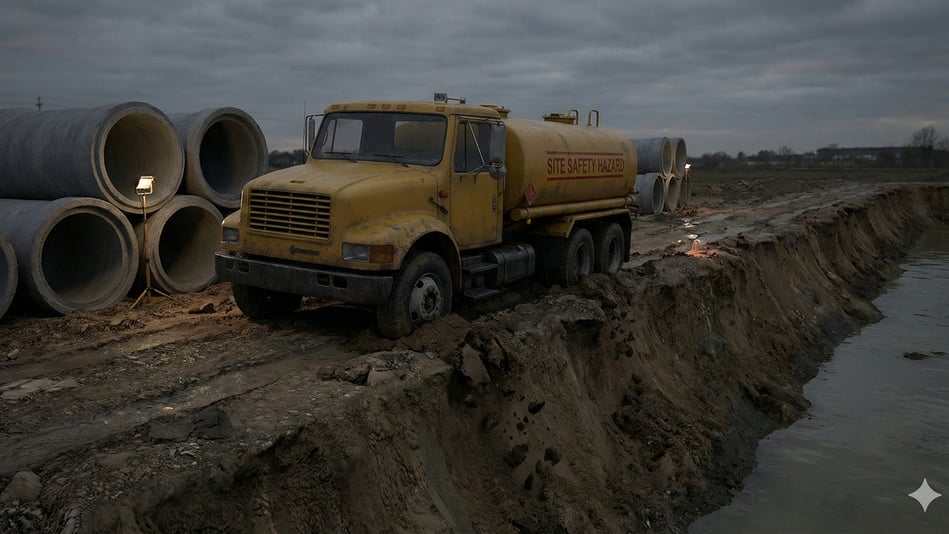
Table of Contents
Case Background
On August 17, 2021, Varnel Johnson Jr. reported for work at the Big Cypress Indian Reservation, where he served as an employee for Ranger Construction Industries, Inc. Mr. Johnson had taken on the responsibility of operating a Caterpillar 725 water truck at a jobsite managed by project superintendent Robert Sumner. Earlier that day, workers had placed large culvert pipes parallel to a canal, significantly narrowing the only available driving path for heavy machinery. High winds began rocking the pipes, so crews placed piles of dirt to stabilize them, which further restricted the already tight passage.
Cause
The accident occurred when Mr. Johnson attempted to navigate the water truck through the narrow gap between the stabilized pipes and the canal. The truck, which measured nearly 10 feet wide, had to traverse a space that investigators later determined was also approximately 10 feet wide. As he drove past, the soft shoulder of the canal gave way under the weight of the heavy equipment. The truck tipped over, flipped upside down, and became fully submerged in the canal.
Injury
Varnel Johnson Jr. remained trapped inside the cab of the overturned truck. Because the vehicle lacked an emergency escape mechanism or air supply, and because he had not been issued a life jacket, Mr. Johnson drowned at the scene.
Damages Sought
Felicia Johnson, acting as the personal representative of her late husband's estate, filed a wrongful death lawsuit seeking more than $50,000 in damages. The claim sought compensation for the loss of Mr. Johnson's support and services, as well as the mental pain and suffering his widow endured. Additionally, the estate requested recovery for funeral expenses and the loss of prospective net accumulations.
Key Arguments and Proceedings
The legal proceedings centered on whether the Defendants' actions met the high threshold of gross negligence or intentional misconduct required to bypass standard worker's compensation immunity.
Legal Representation
Plaintiff(s): Felicia Johnson, as Personal Representative of the Estate of Varnel Johnson, Jr.
Counsel for Plaintiff(s): Roy D. Wasson | Jeffrey Allen
Experts for Plaintiff(s): Allan Tencer | Benjamin Kidder
Defendant(s): Ranger Construction Industries, Inc | Robert Sumner | Caterpillar, Inc.
Counsel for Defendant(s): Benjamin S. Pahl | Jordan Goldfarb | Chantel Wonder | Deidre McGlinchey | Zoe E Nelson | David S. Weinstein
Experts for Defendant(s): Andres Navarro | George Mayforth | Gary R. Rogers | Brad Van De Veer | William Mizel | Jennifer L. Yaek | Thomas Garland
Key Arguments or Remarks by Counsel
Claims Against Ranger and Sumner
The Plaintiff argued that Ranger Construction and Robert Sumner had created a "virtually certain" death trap by forcing Mr. Johnson to drive heavy equipment on a path that was too narrow for the vehicle. Counsel highlighted that OSHA had already cited the company for "serious" violations, including the failure to maintain safe travel paths and the lack of warning signs near the canal. They contended that Mr. Sumner knew the pipes were dangerously close to the water but failed to correct the hazard, showing a conscious disregard for employee safety.
Claims Against Caterpillar
The lawsuit alleged that Caterpillar had designed and sold a defectively dangerous truck. The Plaintiff's counsel argued that the vehicle had an unreasonably high center of gravity and lacked critical safety features, such as sensors to warn of tipping or a sealed cabin to prevent water intrusion during a submersion.
Defense
The Defendants generally denied liability. While specific trial testimony details were limited in the filings, the defense strategy involved questioning the degree of negligence and whether the incident fell under the intentional tort exception to Florida's worker's compensation laws.
Jury Verdict
The jury reached its decision on January 14, 2026, after weighing the evidence against the Defendants.
Gross Negligence and Liability The jury found that Robert Sumner was indeed guilty of gross negligence, which served as a legal cause of Varnel Johnson Jr.’s death. However, the jury also determined that Mr. Johnson bore a degree of negligence himself that contributed to the fatal accident.
Apportionment of Responsibility When assigning percentages of fault, the jury divided the responsibility between the project superintendent and the deceased driver. This percentage serves to reduce the final total of damages awarded to the Plaintiff.
Damages Awarded The jury calculated the total damages sustained by Felicia Johnson for her pain, suffering, and the loss of her husband’s companionship. While the specific dollar amount and fault percentages were filled out on the original form returned to the Court, the verdict confirmed that the legal system held the Defendant accountable for the safety failures that led to the tragedy.