Grossmont Hospital $5.95M Wage & Hour Class Settlement
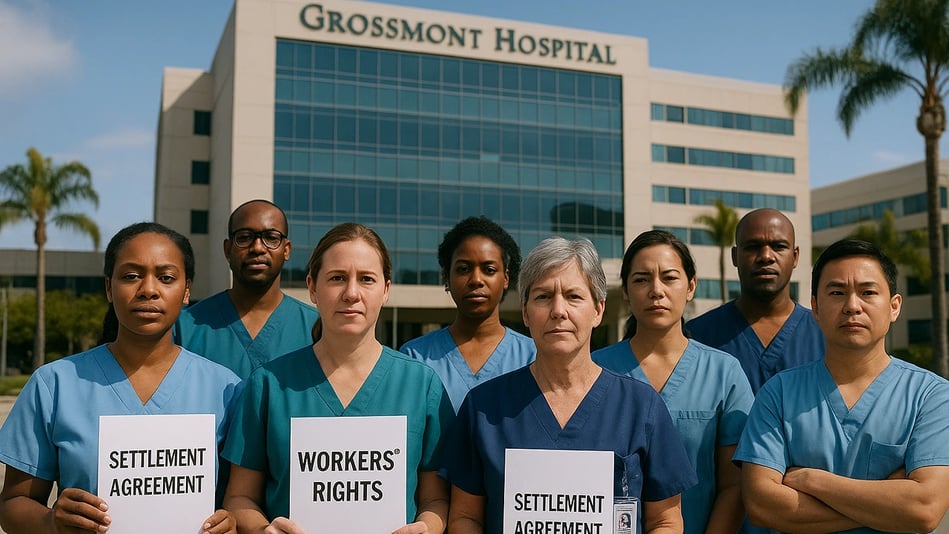
Table of Contents
Case Background
Jacquelyn Cranton and Katrena Arnold filed a class action lawsuit against Grossmont Hospital Corporation alleging systematic wage and hour violations affecting thousands of non-exempt hospital employees. The case proceeded through San Diego Superior Court. Grossmont Hospital operates the largest healthcare facility in East San Diego County, leased to Sharp HealthCare since 1991.
Cause
The violations occurred from January 13, 2018, through March 20, 2024. Cranton began working at Grossmont Hospital in August 2018 as an hourly employee. The hospital required employees to work while clocked out during meal breaks, with supervisors interrupting meal periods for work assignments. The hospital's scheduling prevented legally mandated thirty-minute meal breaks after five hours or second meal breaks after ten hours.
The hospital implemented time-rounding policies favoring the employer and required employees to arrive early for mandatory COVID-19 screenings before clocking in. Workers underwent temperature checks and symptom questionnaires without compensation.
The hospital denied legally required ten-minute rest breaks for every four hours worked. When employees missed breaks, the hospital failed to provide required additional compensation. The hospital also miscalculated overtime by excluding non-discretionary incentive pay from the regular rate calculation, and failed to reimburse employees for work-related cell phone use.
Injury
Employees lost wages for missed meal and rest breaks and incorrectly calculated overtime. Cranton experienced retaliation after complaining in March and April 2021 to manager Jennifer Peters about rest break failures, COVID-19 safety concerns, and patient safety issues. The hospital demoted her from Resource Nurse, denied opportunities, and imposed unreasonable demands.
Damages Sought
The Plaintiffs filed their complaint on January 13, 2022, seeking damages exceeding $30,000 for the class, including unpaid minimum wages, overtime, meal and rest premiums, and unreimbursed expenses. They requested wage statement penalties, waiting time penalties, declaratory relief, and injunctive relief. Cranton sought retaliation damages including back pay and emotional distress.
Key Arguments and Proceedings
Legal Representation
Plaintiffs: Jacquelyn Cranton | Katrena Arnold
· Counsel for Plaintiffs: Norman B. Blumenthal | Kyle R. Nordrehaug | Aparajit Bhowmik
Defendant: Grossmont Hospital Corporation
· Counsel for Defendant: Jody A. Landry | Krystal N. Weaver
Key Arguments or Remarks by Counsel
Claims
The Plaintiffs argued the hospital maintained company-wide policies affecting all non-exempt employees uniformly. They emphasized the hospital failed to provide legally compliant thirty-minute meal breaks before the fifth hour of work. Supervisors interrupted employees during meal breaks with work assignments, meaning breaks were not truly off-duty as required.
For rest periods, the Plaintiffs emphasized California law requires employers to authorize and permit ten-minute paid breaks for every four hours worked, meaning employers must relieve employees of all duties. The hospital's policy prohibiting employees from leaving premises during rest breaks violated California Supreme Court precedent.
The Plaintiffs argued the hospital's failure to include incentive pay in overtime calculations violated established law. The hospital described incentive wages as part of the compensation package to recruits, yet excluded these earnings from overtime calculations.
Requiring COVID-19 screenings before clocking in constituted compensable work time. The hospital made screenings mandatory as an employment condition, benefiting the hospital while denying compensation.
For expense reimbursement, the Plaintiffs argued requiring employees to use personal cell phones for work communications without reimbursement violated California Labor Code Section 2802.
Cranton's retaliation claim centered on adverse actions after she complained about violations. California Labor Code Section 1102.5 protects employees who report illegal conduct.
Defense
The hospital's defense denied most substantive allegations. They argued employees bore comparative fault if they failed to take available breaks or follow policies. They claimed violations resulted from employee choices rather than company practices.
The defense asserted collateral source defenses and invoked Florida's no-fault statute. They argued employees failed to mitigate damages by not obtaining medical treatment or following recommendations.
A significant defense involved federal preemption. The hospital argued some employees were covered by collective bargaining agreements, and claims dependent on interpreting these agreements were preempted by federal labor law. For healthcare workers, they cited special meal period waiver provisions under California law.
The hospital argued violations resulted from good faith errors rather than willful conduct. They raised constitutional challenges, arguing cumulative penalties would constitute excessive fines under the Eighth Amendment.
Settlement
The parties reached a settlement after negotiations assisted by mediator Jeffrey Ross. On March 29, 2024, the Court granted preliminary approval. After notice to class members and a fairness hearing, the Court issued final approval on August 9, 2024.
The settlement provided a gross amount of $5,950,000 to resolve all claims. The class included all non-exempt employees who worked for Grossmont Hospital Corporation in California from January 13, 2018, through March 20, 2024.
The Court found the settlement fair, reasonable, and adequate. The settlement resulted from arms-length negotiations with an experienced mediator. Both sides had experienced employment attorneys who recommended approval. The participation rate was exceptionally high with no objections.
The settlement was not an admission of liability by Grossmont Hospital. The case demonstrated how systematic wage and hour violations affecting thousands of workers can result in substantial class action settlements. The high participation rate and lack of objections suggested class members found the settlement fair.
Court documents are available upon request at jurimatic@exlitem.com