$2.1M Motor Vehicle Negligence Verdict
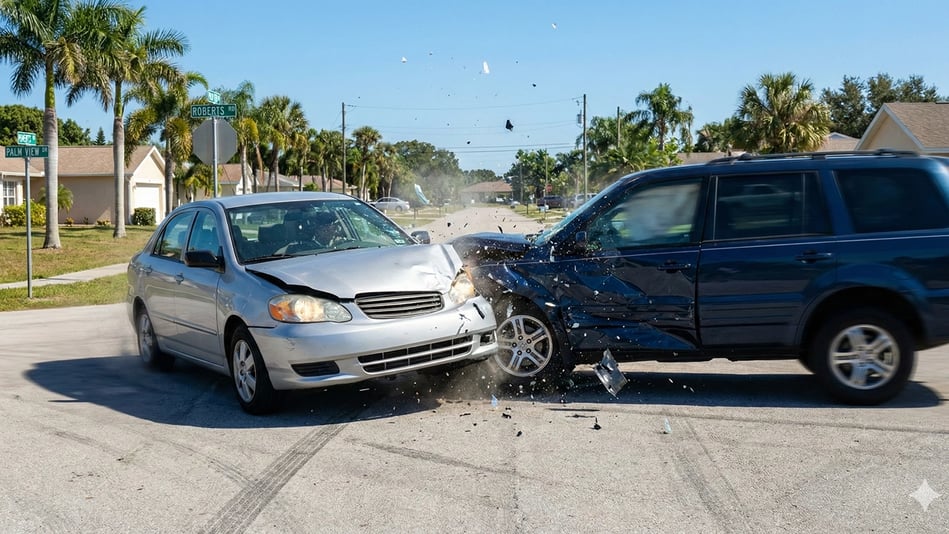
Table of Contents
Case Background
On December 25, 2022, a motor vehicle collision occurred on Roberts Road in Saint Johns, Florida, that would trigger a legal dispute spanning nearly three years. Yasmin Razavipour was driving north on Roberts Road when Dylan Tarongoy attempted a left turn in front of her vehicle, violating her right of way and causing a serious crash. The impact left Razavipour with substantial injuries and medical bills, setting the stage for litigation against both the driver and vehicle owner, as well as the insurance company involved.
Razavipour filed suit in the Fourth Judicial Circuit Court in Duval County, Florida, in March 2023, initiating a case that would eventually proceed to trial. The case number 2023-CA-002235 involved three primary Defendants: Dylan Tarongoy, the driver of the vehicle; Nathaniel Tarongoy, the vehicle's owner; and USAA General Indemnity Company, Razavipour's insurance provider. By July 2025, the matter came before a jury for final resolution.
Cause of the Accident
The Collision
The accident stemmed from a left-turn violation. Dylan Tarongoy was operating a vehicle that belonged to his co-Defendant Nathaniel Tarongoy when he attempted to turn left onto Roberts Road without yielding to oncoming traffic. Razavipour's vehicle was lawfully traveling north on Roberts Road in the proper lane. Tarongoy's failure to yield the right of way caused the vehicles to collide with considerable force. The Plaintiff's complaint alleged that Tarongoy operated the vehicle negligently in multiple ways, including failing to maintain a proper lookout, operating at excessive speed, driving while distracted, and failing to take evasive action to avoid the collision.
Injury and Medical Consequences
Nature of Injuries
Razavipour sustained serious injuries from the collision. She suffered pain throughout her body, sustained scarring and disfigurement, and experienced significant emotional distress. The Plaintiff's medical records documented that she either sustained new injuries or aggravated a pre-existing physical condition. Beyond the immediate physical trauma, Razavipour endured mental anguish and inconvenience related to her ongoing recovery. Most significantly, medical evidence established that her injuries met the threshold for permanent injury, satisfying Florida's serious injury requirement for motor vehicle cases.
The permanent nature of Razavipour's injuries became a central focus of the litigation. The Plaintiff's medical team determined within a reasonable degree of medical probability that she would experience lasting physical impairment. She lost capacity to enjoy her normal life activities, and her earning potential declined due to her physical condition.
Damages Sought
Compensation Components
Razavipour pursued several categories of compensation through her lawsuit. She sought recovery for all past medical expenses reasonably incurred to treat her injuries, which totaled $113,680.60. Looking forward, she requested compensation for future medical care and treatment anticipated to cost $400,000. Additionally, Razavipour claimed damages for her pain and suffering in the past, as well as ongoing pain and suffering extending into the future. She requested compensation for lost wages from the time of the accident through trial, and damages for the permanent impairment to her earning capacity going forward.
The Plaintiff also pursued an underinsured motorist claim against her own insurance carrier, USAA, seeking recovery under her policy's uninsured/underinsured motorist coverage, which provided $400,000 in protection.
Key Arguments and Proceedings
Legal Representation
Plaintiff(s): Yasmin Razavipour
· Counsel for Plaintiff(s): Fraz Ahmed | Dana A. Jacobs
· Experts for Plaintiff(s): Mark S. Frisk | Rick Robinson | Richard J. Boehme | Christopher Roberts | Vincent Galiano | Andrew Cannestra | William J. Fischer
Defendant(s): Dylan Tarongoy | Nathaniel Tarongoy | USAA General Indemnity Company
· Counsel for Defendant(s): William P. Cassidy | Elizabeth Ann Santiago | Scott Andrew Shelton | Warren Kwavnick | Thomas Corley Smith | Thomas Daniel Webb
· Experts for Defendant(s): David Rosenbach | C. Brian Moody | Daniel P. Robertson
Key Arguments Presented
Plaintiff's Position
Razavipour's counsel presented evidence that Dylan Tarongoy breached his legal duty to exercise reasonable care while operating the motor vehicle. The Plaintiff's team demonstrated through testimony and physical evidence that Tarongoy failed to maintain a proper lookout, which is the fundamental responsibility of every driver. The evidence established that Tarongoy operated at a speed inappropriate for existing traffic conditions, further contributing to his inability to avoid the collision. Counsel emphasized that Razavipour maintained a lawful position on the roadway and had the right of way when Tarongoy's vehicle struck hers.
The Plaintiff's team also presented evidence of Tarongoy's comparative negligence, establishing his responsibility for the accident and demonstrating that Razavipour's own conduct minimally contributed to the collision. Medical experts testified regarding the severity of Razavipour's injuries, the permanence of her condition, and the realistic costs for her ongoing treatment. The Plaintiff's counsel painted a compelling picture of a person whose life changed dramatically due to another's negligent driving.
Defense Arguments
USAA's counsel took a limited approach at trial. The insurance company admitted that USAA had issued an insurance policy to Razavipour containing underinsured motorist coverage in the amount of $400,000. USAA further stated it was not asserting coverage defenses at the time of litigation. However, the insurance company reserved rights based on the terms, conditions, and exclusions contained within the policy itself. The defense maintained that any liability would be strictly limited to the policy's coverage amounts and terms.
Regarding comparative fault, the defense argued that Razavipour bore some responsibility for the collision. The Defendants raised an affirmative defense claiming the Plaintiff failed to mitigate damages, suggesting she did not take all reasonable steps to minimize the impact of her injuries or the costs of her recovery.
Claims Brought Before the Jury
Negligence Against Dylan Tarongoy
The primary claim alleged that Dylan Tarongoy negligently operated the vehicle through multiple breaches of his legal duty. The Plaintiff's negligence claim encompassed the driver's failure to maintain a proper lookout, operation at excessive speed, distracted driving, failure to maintain vehicle control, and failure to yield the right of way.
Vicarious Liability Against Nathaniel Tarongoy
A separate claim sought to hold Nathaniel Tarongoy liable for his co-Defendant's negligence based on vicarious liability and dangerous instrumentality doctrine. This claim rested on the fact that Tarongoy owned the vehicle and gave permission to Dylan Tarongoy to operate it, potentially making the owner liable for the driver's negligent conduct.
Uninsured Motorist Claim Against USAA
The Plaintiff brought an underinsured motorist claim against USAA, her insurance carrier, seeking recovery under the policy's uninsured/underinsured motorist coverage provisions.
Defense Arguments Presented at Trial
The Defendants raised several affirmative defenses. They argued that any damages would be reduced by the amount of personal injury protection insurance available to Razavipour under Florida's no-fault system. The defense further contended that the Florida Automobile Reparations Reform Act, commonly known as the no-fault law, might bar the entire lawsuit. USAA emphasized that its potential liability would be strictly limited to the policy limits and the terms set forth in the insurance contract, citing Section 627.727 of the Florida Statutes.
The defense also presented the failure-to-mitigate argument, suggesting that Razavipour's damages should be reduced to the extent that she failed to take reasonable steps to minimize her losses.
The Jury's Decision
On July 18, 2025, the jury returned a verdict finding Dylan Tarongoy liable for negligence. The jury determined that Tarongoy's negligent conduct constituted a legal cause of loss, injury, and damage to Razavipour. In response to special interrogatories, the jury also found that Razavipour bore some degree of comparative negligence, assigning 15 percent responsibility to her and 85 percent to Tarongoy. The jury's breakdown indicated that Tarongoy's conduct was substantially more culpable than Razavipour's minor negligence.
On the issue of permanent injury, the jury concluded that Razavipour sustained a permanent injury within a reasonable degree of medical probability, satisfying this critical element of her claim.
Damages Awarded
The jury awarded Razavipour $113,680.60 for past medical expenses she reasonably and necessarily incurred as a direct result of the collision. For future medical care and treatment, the jury determined the reasonable value to be $400,000, reflecting the ongoing nature of her injuries and anticipated treatment requirements.
Regarding non-economic damages, the jury awarded nothing for past pain and suffering, assigning a value of $0. However, for future pain and suffering, disability, physical impairment, disfigurement, mental anguish, inconvenience, and loss of capacity to enjoy life, the jury determined that Razavipour should receive $1,600,000. This substantial award reflected the jury's assessment that Razavipour faced significant ongoing suffering throughout her life as a result of Tarongoy's negligence.