$113K Verdict in Saucedo v. Farrar Rear-End Collision Case
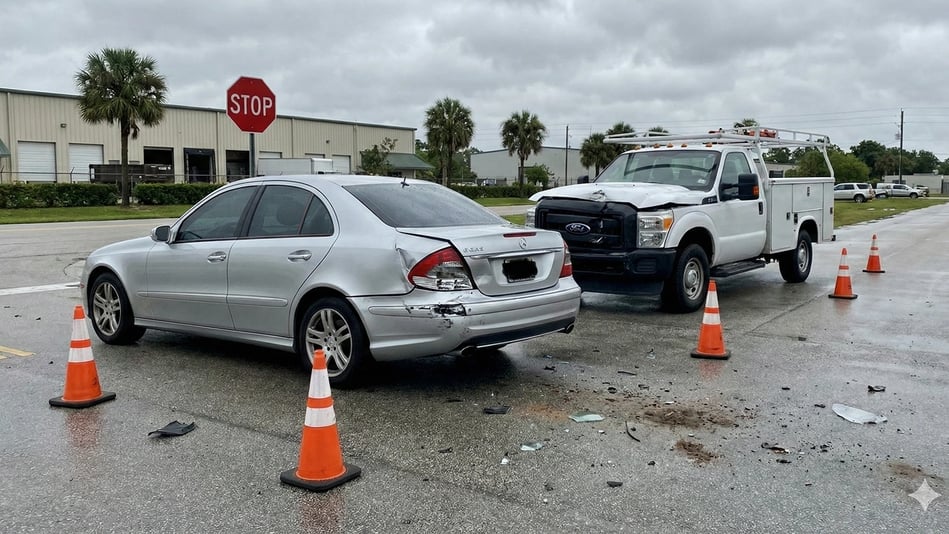
Table of Contents
Case Background
Alejandro Atanacio Saucedo, a Duval County, Florida resident, filed a personal injury lawsuit against Michael Leslie Farrar and Rite-Hite Holding Corporation following a rear-end collision that occurred on January 25, 2023. The accident took place on Port Jacksonville Parkway in Jacksonville, Florida, when Saucedo was stopped at a stop sign due to vehicles ahead of him. Farrar, who was driving a company vehicle owned by Rite-Hite Holding Corporation, struck the rear of Saucedo's 2004 Mercedes E320.
Cause
According to the complaint, Farrar operated the motor vehicle in the course and scope of his employment with Rite-Hite Holding Corporation, a Wisconsin-based company with its principal office in Milwaukee. Saucedo alleged that Farrar negligently operated the vehicle by failing to reduce speed to avoid a collision, following too closely, failing to keep a proper lookout, and driving carelessly. The complaint stated that Farrar rear-ended Saucedo's vehicle while Saucedo was lawfully stopped at a stop sign waiting for traffic to clear.
Injury
Saucedo claimed he suffered bodily injuries including permanent injury to the body as a whole, pain and suffering of both a physical and mental nature, disability, physical impairment, disfigurement, and mental anguish. He also alleged inconvenience, loss of capacity for the enjoyment of life, aggravation of an existing condition, and activation of a latent condition. The complaint further stated that Saucedo incurred expenses for hospitalization, medical and nursing care and treatment, experienced loss of earnings, diminished earning capacity, and loss of ability to lead and enjoy a normal life. His 2004 Mercedes E320 also sustained property damage in the collision.
Damages Sought
Saucedo's complaint stated that the amount in demand exceeded fifty thousand dollars, exclusive of costs, interest, and attorneys' fees. He sought past and future medical expenses, property damage to his vehicle, compensation for pain and suffering, and costs of the action.
Key Arguments and Proceedings
Legal Representation
Plaintiff: Alejandro Atanacio Saucedo
· Counsel for Plaintiff: Timothy S. Moran | Albert Heinz Lechner | Nicholas Edward Concilla | Michelle Fallyn Kaplin-Zhebrak
· Experts for Plaintiff: Mark S. Frisk | Timothy Osbon | J. Rody Borg | Chris A. Yates | Nick Schumacher | Scott Wiedenmann | Michael Chanatry | Scott Kowalski | Joseph Mark Graham
Defendants: Michael Leslie Farrar | Rite-Hite Holding Corporation
· Counsel for Defendants: Derek J. Bush | Shyla A. Bostick | Sean Michael McDonough | Gia Lorraine Domenico
· Experts for Defendants: Stephen Durham | J. Kevin Brooks | Joseph Kleinman | Julianne Frain | Andrew Cherepon
Claims
The complaint contained two counts against the Defendants.
Negligence Against Michael Leslie Farrar: Saucedo alleged that Farrar owed a duty to other motorists to reduce speed to avoid a collision, follow other vehicles at a safe distance, and keep a proper lookout. Saucedo claimed Farrar breached this duty by traveling too fast for conditions, following too closely, failing to keep a proper lookout, and driving carelessly, which directly caused the accident and resulting injuries.
Vicarious Liability Against Rite-Hite Holding Corporation: Saucedo sought to hold Rite-Hite Holding Corporation responsible under Florida's dangerous instrumentality doctrine as the owner of the vehicle Farrar operated. Additionally, Saucedo alleged the company was vicariously liable under respondeat superior since Farrar was acting in the course and scope of his employment at the time of the accident. The complaint also alleged that Rite-Hite negligently allowed Farrar to operate the vehicle, failed to properly supervise him, failed to instruct him on proper vehicle operation, and failed to ensure he understood the rules and laws concerning vehicle operation.
Defense
The Defendants filed an answer and raised multiple affirmative defenses in response to Saucedo's complaint.
Comparative Negligence: The Defendants argued that Saucedo's own negligence proximately contributed to causing the accident and any resulting damages. They alleged he failed to conduct himself in a reasonably careful manner and failed to exercise due care at the time of the accident.
Third Party Causation: The Defendants claimed that Saucedo's injuries were caused by third parties or other individuals over which they had no control.
Failure to Meet Threshold Injury: The Defendants asserted that Saucedo failed to sustain a threshold injury as defined by the Florida No-Fault Statute and therefore was not entitled to recovery of non-economic damages.
Seat Belt Defense: The Defendants alleged that Saucedo was not wearing a seat belt at the time of the accident and therefore was not entitled to recover, or his damages should be diminished.
Pre-Existing Condition: The Defendants claimed that some or all of Saucedo's injuries were based upon a pre-existing, congenital, or hereditary condition for which they were not responsible.
Greater Than Fifty Percent at Fault: The Defendants argued that Saucedo was greater than fifty percent at fault for causing his own harm and therefore could not recover any damages under Florida Statute Section 768.81(6).
Jury Verdict
The jury delivered its verdict on November 14, 2025, in the Fourth Judicial Circuit Court in and for Duval County, Florida. The jury found that the negligence of Defendant Michael Leslie Farrar was a legal cause of loss, injury, or damage to Plaintiff Alejandro Atanacio Saucedo.
The jury awarded Saucedo medical expenses in the amount of $80,808.05 for expenses incurred in the past and $32,323.22 for medical expenses to be incurred in the future, for a total medical expense award of $113,131.27.
However, the jury found that Saucedo did not sustain a permanent injury within a reasonable degree of medical probability as a result of the January 25, 2023 collision. Because the jury answered no to the permanent injury question, they did not award any damages for pain and suffering, mental anguish, disability, physical impairment, inconvenience, or loss of capacity for the enjoyment of life, either in the past or in the future.
The verdict represented a partial victory for Saucedo, who recovered his medical expenses but was denied compensation for non-economic damages. The jury's finding that he did not suffer a permanent injury meant he could not recover for pain and suffering under Florida's no-fault threshold requirements. The foreperson signed the verdict form on November 14, 2025, confirming the jury's decision.
This case demonstrates the importance of the permanent injury threshold in Florida motor vehicle accident cases. While the jury found the Defendant negligent and awarded substantial medical expenses totaling over $113,000, the Plaintiff's inability to prove permanent injury under Florida law prevented recovery of potentially significant non-economic damages for pain, suffering, and diminished quality of life.
Court Documents