Ramos v. Miami-Dade: $8K Verdict in Multi-Party Crash

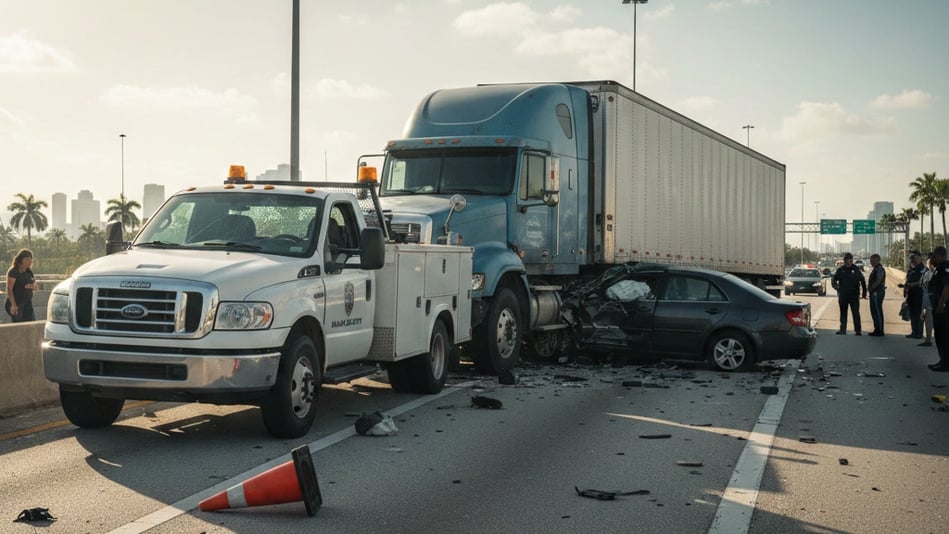
Table of Contents
Case Background
This legal battle began when Griselle Ramos filed a lawsuit against Miami-Dade County following a traumatic incident that changed her life. The case, identified as Case No. 2022-05172-CA-01, landed in the General Jurisdiction Division after Ramos alleged that the County's negligence directly caused her significant harm. The core of the dispute focused on whether the County and other involved parties failed in their duty to maintain a safe environment, leading to a collision or accident that left Ramos with lasting physical and financial burdens.
Cause
The trouble started when Ramos encountered a dangerous situation involving a vehicle operated by Miami-Dade County. The legal complaint highlighted a chain of events where the County’s actions, alongside the conduct of John Chaparro and the driver of a parked semi-truck, created a hazardous scenario. Ramos argued that the collective negligence of these parties served as the legal cause of the incident. Before the trial even began, the County had denied these allegations, claiming it had no knowledge of specific details or simply refuting the claims of wrongdoing.
Injury
The incident left Ramos with more than just a damaged vehicle; she suffered injuries that her legal team argued were permanent. Beyond the immediate physical pain, the injuries impacted her ability to enjoy life and required ongoing medical attention. The jury eventually determined that these injuries met the threshold of being permanent within a reasonable degree of medical probability.
Damages Sought
Ramos sought compensation for a variety of losses stemming from the accident. Her demands included payment for medical expenses she had already paid out of pocket. Furthermore, she looked for "non-economic" damages to cover the intangible toll of the accident: her physical impairment, the mental anguish she endured, the scarring on her body, and the general loss of her capacity to enjoy daily activities. She also sought funds for future pain and suffering, anticipating that her recovery would never truly be complete.
Key Arguments and Proceedings
During the proceedings, the Courtroom transformed into a battlefield of facts and technicalities. The County’s legal team filed an answer to the amended complaint in June 2022, setting the stage for a long pre-trial phase. They argued early on that Ramos had failed to follow the proper legal procedures for suing a government entity, specifically citing Florida statutes that govern sovereign immunity and the presentation of claims.
Legal Representation
Plaintiff(s): Griselle Ramos.
· Counsel for Plaintiff(s): Avery Fenton | Philip Merenda | Frederick Pye | Andres Hermida | Carlos O. Fernandez | Chauncey Dean
· Experts for Plaintiff(s): George El-Bahri
Defendant(s): Miami-Dade County.
· Counsel for Defendant(s): Lepore Korissa | Ela Hernandez | Richard D. Schevis, Esq.
· Experts for Defendant(s): Jonathan Gottlieb | Michael J. Foley | Ming Xiao
Key Arguments or Remarks by Counsel
The lawyers for Miami-Dade County did not hold back, presenting a massive list of 41 distinct defenses to shield the local government from a high payout. They argued that the accident was not the County’s fault alone and that the legal system needed to look at everyone involved. They pushed the idea that Ramos herself shared the blame, which would legally reduce any money the County might owe her.
Claims
The central claim was straightforward: the County acted negligently. Ramos’s team argued that the County's employee or vehicle operation fell below the standard of care expected on public roads. They also brought John Chaparro and a semi-truck driver into the mix, claiming that their combined negligence set the stage for the disaster.
Defense
The County’s defense strategy was multi-layered. They first argued that Ramos had been negligent herself by failing to drive her car in a reasonable manner. One of their most pointed arguments focused on a seat belt; they claimed that Ramos had a working seat belt available but chose not to use it, which significantly worsened her injuries. They also suggested that the accident might have been caused by a "sudden emergency" or a mechanical failure that they could not have predicted even with reasonable care. Furthermore, they claimed immunity under various Florida laws, suggesting that as a sovereign entity, they were protected from certain types of lawsuits.
Jury Verdict
After years of litigation, the jury finally reached a decision on January 16, 2026. After the foreperson, Amalia Rodriguez Colon, read the results, it became clear that the jury found negligence on several fronts.
Findings of Negligence The jury decided that Miami-Dade County was indeed negligent and that this negligence served as a legal cause of damage to Griselle Ramos. However, the County was not alone in the blame. The jury also found that John Chaparro and the driver of the parked semi-truck had been negligent.
Allocation of Fault To determine how much the County would actually have to pay, the jury had to split the blame into percentages. They assigned the following fault:
Miami-Dade County: 35%.
John Chaparro: 20%.
Driver of the parked semi-truck: 45%.
The Financial Award The jury calculated the total damages Ramos sustained. They awarded her $8,335.20 specifically for medical expenses she had incurred in the past. Because they found she had suffered a permanent injury, they were authorized to award more, though the final total on the verdict form matched her past medical costs, suggesting a very specific focus on her documented expenses.
The case concluded with the jury's clear message: while the County was the primary party at fault, the incident was a complex web of negligence involving multiple people.